
New homeowners, best fit for life insurance first.
A new mortgage is when families think about covering it. Every home that changed hands in your county, scored on five signals of a strong life insurance prospect, with the best fits on top.
Pick your zip or countyOpen the demo
One life insurance agent per zip or county: $300 to $900 a quarter for a zip, $1,500 to $3,500 for a whole county. 6,900 homes changed hands in the last 90 days across Wake County, Davidson County, the Tri-Cities and Watauga County, and 2,902 of those buyers hit 4 or 5 of the 5 signals.
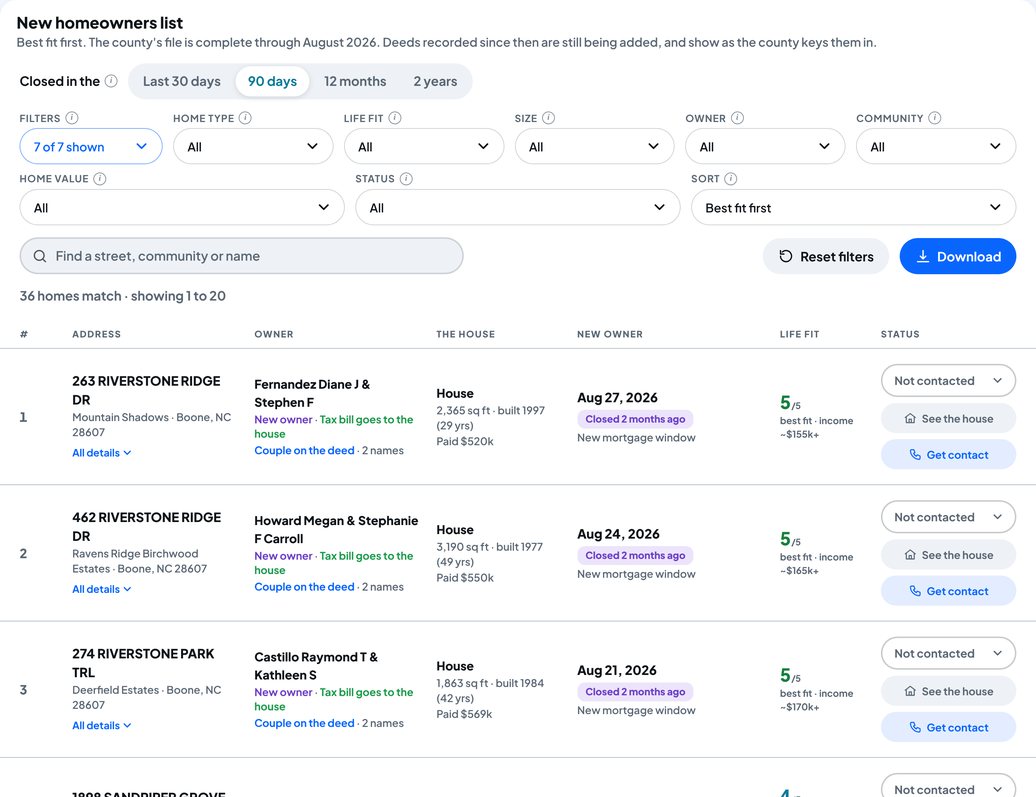
What you get with a life insurance county
- Every home that changed hands in the county, best fit first: the last 30 days, 90 days, 12 months or 2 years on file
- A life fit score on every home, out of 5: bought in the last 90 days, lives there, two or more names on the deed, household income of about $90k to $225k, and a family-size home
- The owners' names, the mailing address, and whether the tax bill goes to the house (they live there) or somewhere else (a rental or second home)
- The closing date and the recorded price in North Carolina and Tennessee. Texas publishes neither, so Austin has no closing dates and its income estimate uses the county value
- The owner's phone and email with one tap on Get contact, with Do Not Call numbers marked, and the owner's age when the phone records list it
- A log on every home of each call and email, with the date, so you know when a follow-up is due
- Filters for life fit, home type, size, value, community and owner, and a download with every column, with Street View on every home
$1,500 to $3,500 a quarter for the whole county, by its size, or $300 to $900 for one zip. No setup fee, and no other life insurance agent gets your zips or your county. A refresh every month, with the date the county's file runs through shown on your list.
How the list finds your best prospects
Why new homeowners?
A new mortgage is the biggest debt most families take on, and one of the most common reasons to buy term life. The first weeks after closing are when they're thinking about what happens to the house if something happens to them. The deed is the public record that says it just happened.
What are the five signals?
Bought in the last 90 days, by the closing date. Lives there: the tax bill goes to the house, so it isn't a rental or a second home. Two or more names on the deed, usually a married or partnered couple, and each one is a policy. A household income of about $90k to $225k, estimated from the price. And a family-size home: 3 or more bedrooms, or 1,600 or more square feet. A home owned by a company or trust fits none of them.
How is the income estimated?
At about 30% of the price paid. Lenders keep a mortgage payment near 28% of income, so most buyers make at least that much. Cash buyers and big down payments break the rule, so treat it as a floor, not a fact. Austin uses the county value, since Texas publishes no prices.
What isn't in the records?
Age, income, children, health, and any life insurance they already have, including through work. The five signals stand in for what public records can't show. Ask on the call: who depends on your income, what coverage you have now, and what monthly amount would feel comfortable. When the phone records list the owner's age, Get contact shows it.
Did these people ask for a quote?
No. This is a cold list built from public records, and nobody on it asked to be contacted. The fit score ranks who to reach first; it doesn't mean they're shopping.
Do I get phone numbers?
Yes. Press Get contact on any home and we look up the current owner's phone numbers and email. If the records only turn up a past owner, you get nothing instead of the wrong person's number. Your team gets 500 lookups per zip each quarter, and a lookup that finds nobody doesn't count. Numbers on the National Do Not Call Registry come marked, with the rule for when you may call them, and numbers tied to people known for suing over sales calls are left out. Tennessee and Texas keep state lists too, so check those before you call there. Autodialed or prerecorded calls and texts to cell phones need written consent first. Mail has no such rule.
How fresh is the list?
As fresh as the county keys deeds in. Wake County posts sales within a few weeks of recording. Watauga County and the Tri-Cities counties run a month or two behind, and the app shows the date each file is complete through, so you know whether a quiet week is real or still being keyed in. Every list is refreshed monthly.
Who else gets my county?
Nobody in life insurance. Each county goes to one life insurance agent, for as long as they keep it. Window cleaning and pest control companies can buy the same county for their own trade; they are not competing with you.